
AI Integration Opportunities for Residential Property Management: 7 Workflow Automations to Explore (Without Replacing Your PMS)
- Sam Weinstein
- Mar 30
- 9 min read

Introduction: When more doors creates more messages than your team can handle
A familiar scenario plays out in many mid-market residential property management firms. Unit count is growing—sometimes steadily, sometimes in bursts from new owner relationships or acquisitions—yet staffing does not scale at the same rate.
The team’s day becomes a cycle of context switching across maintenance, leasing, accounting, owners, residents, vendors, and prospects.

In a typical day:
A resident text comes in about “water everywhere,” but it’s unclear which unit.
An owner emails asking why repairs spiked this month.
A vendor sends an invoice PDF that needs coding and matching to a work order.
A prospect calls after hours with questions about pet policy, fees, and showings.
Accounting is trying to close the month while leasing is chasing missing application documents.
Most firms already have a property management system (PMS) as the system of record—AppFolio, Buildium, Rent Manager, Propertyware, Yardi, or another platform. Many also have point tools layered on top: screening, inspections, showing schedulers, shared inboxes, phone systems, and spreadsheets that quietly hold operational exceptions.
In that reality, the most promising role for AI is often not “replace your tools,” but to connect them.
An integration-first philosophy treats AI as a workflow layer that:
Converts unstructured inputs (emails, texts, call notes, PDFs, photos) into structured records in the PMS.
Routes work to the correct role (maintenance coordinator, leasing, accounting, portfolio manager).
Automates follow-ups and status updates so nothing slips through.
Adds guardrails for risk areas like after-hours emergencies, permissions, and Fair Housing-sensitive messaging.
Below are seven AI integration opportunities residential property managers should explore—especially firms managing roughly 500–5,000 doors—where the goal is operational throughput: more doors per employee, without sacrificing service quality.
The integration-first lens: keep the PMS as the system of record
Before diving into the opportunities, clarify an architecture principle that reduces adoption risk:
The PMS remains the source of truth for leases, ledgers, work orders, resident and owner records, and core reporting.
AI sits in the workflow layer—reading inbound messages and documents, suggesting actions, and writing structured updates back into the PMS.
Existing tools remain in place (shared inbox, phone/SMS, inspection tools, e-signature, showing scheduler, Drive/OneDrive/Dropbox). The goal is orchestration, not tool churn.
This matters because property management work is full of edge cases: exceptions, disputes, habitability concerns, vendor constraints, legal notices, and owner preferences. AI should assist and escalate—not silently decide.
A useful test: if the AI integration fails for an hour, your business should still operate. That pushes the design toward lightweight integrations, clear escalation rules, and reversible workflows.
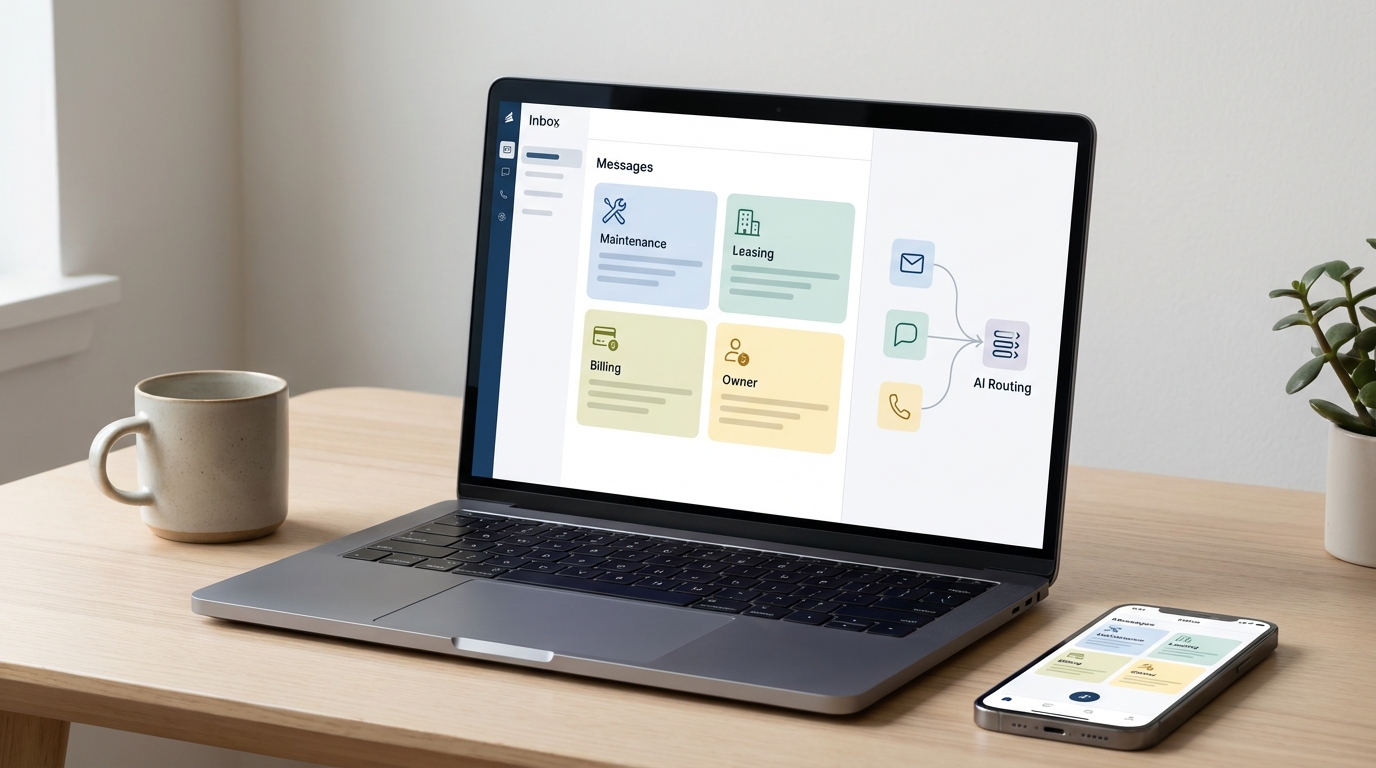
Opportunity 1: AI omnichannel front desk router (shared inbox + SMS + voice)
The operational problem
Most residential PM firms eventually become message-processing organizations. Residents, owners, vendors, and applicants contact the office through multiple channels—email, portal messages, SMS/text, phone calls, and voicemails.
When volume rises, humans become routers: Is this maintenance or billing? Is it urgent? Who owns this property? Did we already respond? Missed follow-ups and inconsistent responses are common symptoms.
The integration opportunity
Implement an AI triage service connected to your existing channels (Microsoft 365/Gmail, phone/SMS provider, shared inbox tool). The AI can classify inbound messages, extract key fields, draft a suggested response using approved templates, create/update the correct record in the PMS (task, note, ticket, work order draft, guest card update), and escalate emergencies via rule-based triggers (e.g., fire, gas smell, no heat, water leak, lockout).
The most important design choice: the AI should not be an unbounded chatbot. It should be a triage-and-assist layer that suggests actions and routes work to humans when needed.
Guardrails worth building in
Role- and category-based permissions (what it can auto-send vs. what it must draft for approval).
After-hours escalation paths (on-call rotation, emergency vendor list, and clear call-911 policy when applicable).
Fair Housing-aware templates for leasing and screening-related messages.
Audit trail logging every classification, outbound message, and PMS update.
Where this tends to help first
Teams often start with 2–3 categories to reduce risk and measure accuracy: maintenance triage, leasing inquiries, and rent/billing FAQs.
Metrics to monitor
Median and 90th percentile first-response time.
Percent of messages correctly auto-tagged (QA sample).
Number of follow-ups automatically sent (and their resolution rate).
Escalation rate and false-emergency rate.
Opportunity 2: Maintenance intake to work order creation to vendor dispatch automation
The operational problem
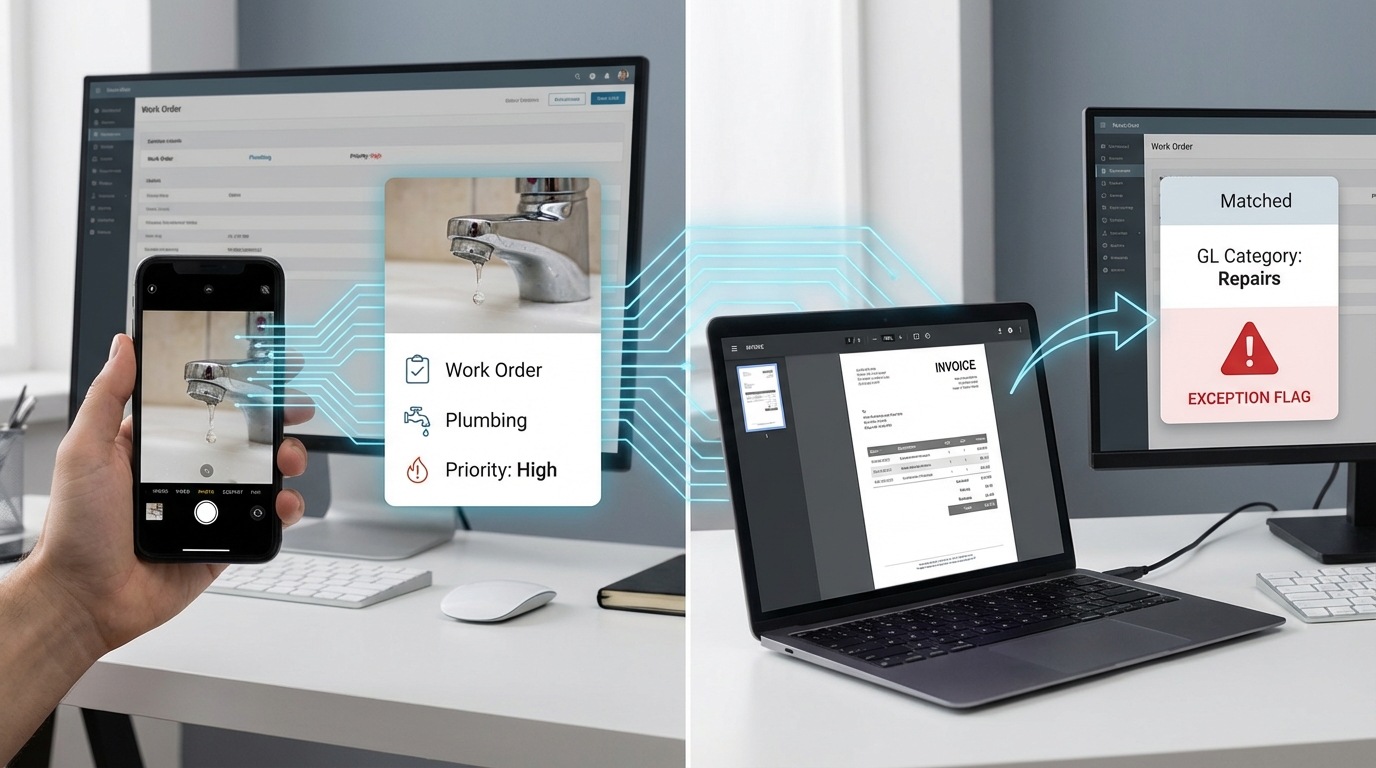
Maintenance coordination becomes a scaling wall because it includes three hard things at once: translating free text into a structured work order, determining urgency (habitability and safety), and coordinating multiple parties with repeated status touches.
The integration opportunity
A maintenance automation layer can parse requests from email/SMS/portal; extract structured details (unit/property, category, severity, availability windows, entry instructions, required photos/videos); create/update a work order in the PMS; suggest the appropriate vendor based on trade, service area, preferred lists, availability, and owner constraints; and automate routine status updates (appointment confirmation, scheduled/completed messages, vendor photo/invoice requests, resident satisfaction check).
What integration-first looks like
Instead of replacing your process, connect the channels where requests arrive, the PMS work order module, the vendor contact method (email/SMS), your vendor list and rules (approved vendors, after-hours routing), and any specialized tools you already use—while keeping final record alignment in the PMS.
Risk management and escalation
Separate routine from high-risk workflows; high-risk keywords route directly to on-call humans.
Resident messages include approved safety instructions (e.g., shut off water if safe; contact emergency services when appropriate).
Configure owner notification triggers for major repairs, over-threshold estimates, or habitability concerns.
Metrics to monitor
Work order cycle time (open → scheduled → complete).
Status touches per work order (goal: fewer human touches).
Percent of work orders created with correct category/severity.
Repeat work order rate for the same issue within 30/60/90 days.
Opportunity 3: Lead-to-lease conversational leasing copilot (FAQ + tour booking + follow-up)
The operational problem
Leasing teams often operate under an inbox-and-phone avalanche: repetitive FAQs (pet policy, fees, income requirements), immediate response expectations (including after hours), showing coordination and rescheduling, no-shows, and incomplete applications with missing documents.
At scale, the issue is not just answering questions; it is maintaining a consistent follow-up cadence.
The integration opportunity
A controlled leasing assistant can respond via web chat and SMS (optionally voice), answer policy questions using a curated knowledge base, qualify prospects (move-in date, household size, pets, preferred neighborhoods), schedule tours using your existing showing tools and calendars, update the PMS guest card with structured notes, and run follow-up sequences (tour reminders, post-showing feedback, application nudges, missing-items checklists).
Practical constraints
Leasing is compliance-sensitive. Use approved language templates for criteria and screening steps, clear handoff-to-human rules for edge cases, and log conversations in the PMS for transparency.
Metrics to monitor
Lead response time and percent contacted within a defined SLA.
Tour conversion rate (lead → scheduled tour).
No-show rate.
Application completion rate and average days-to-lease.
Opportunity 4: Lease packet, renewal, and move-in checklist automation
The operational problem
Lease packets and renewals look simple until they’re not. Small inconsistencies create big costs: missing jurisdiction-specific addenda, incorrect fees or charges, wrong dates or prorations, misfiled executed documents, and incomplete move-in tasks (inspection, keys, portal onboarding).
The work is also repetitive: assembling templates, copying data, and coordinating signatures.
The integration opportunity
An AI-driven document workflow can pull canonical data from the PMS (tenant, property, rent, dates, fees), apply a rules engine to determine the correct addenda set (city/state requirements, property type, pet/HOA/lead paint disclosures as applicable), generate packets from approved templates, route to your existing e-sign tool (DocuSign/Dropbox Sign/Adobe Acrobat Sign), create tasks (move-in inspection scheduling, welcome message scheduling, utilities onboarding, key pickup), and store executed documents in Drive/OneDrive/Dropbox while linking back to the PMS.
Metrics to monitor
Lease packet prep time per lease or renewal.
Error/redo rate (missing addenda, incorrect charges).
Move-in task completion rate prior to lease start date.
Renewal cycle time.
Opportunity 5: Owner reporting narrative generator + guarded owner Q&A experience
The operational problem
Owners rarely want more data—they want clarity. They ask why expenses spiked, what happened with ongoing issues, why vacancy is longer than expected, and what the plan is next month.
Staff often generates the same narratives repeatedly, pulling from accounting, work orders, and leasing updates.
The integration opportunity
A reporting layer can extract key monthly events from the PMS (move-ins/move-outs, delinquencies, major work orders/capex, preventive maintenance notes, leasing milestones) and produce an owner-friendly narrative summary: what happened, what it cost (high level, linked to statements), and what’s next (open work orders, leasing plan).
A second layer is a guarded Q&A experience for owners that answers only property-scoped questions and policy/fee questions based on approved documents, with strict permissions and scoped data sources.
Metrics to monitor
Owner inquiry volume per door per month.
Time spent on owner communications around month-end.
Close-to-send time for owner statements and summaries.
Owner retention and referral signals (tracked internally).
Opportunity 6: Accounting close and AP smart invoice assistant (coding + matching + exceptions)
The operational problem
Vendor invoices arrive as PDFs in an AP inbox and create a predictable month-end scramble: matching invoices to work orders, coding to the correct property/unit and GL, detecting duplicates and outliers, handling vendor compliance gaps (W-9/COI), and drafting explanations for owners when charges look unusual.
The integration opportunity
A smart invoice workflow can ingest invoices, extract fields (vendor, amount, dates, line items, property/unit clues), match to open work orders/vendor records, create bill drafts in the PMS (or queue for approval) with suggested GL coding, flag exceptions (out-of-range amounts, duplicates, missing compliance docs, not-to-exceed threshold issues), and generate draft variance explanations for internal use.
This is not about automating judgment calls—it is about accelerating the first pass and isolating exceptions.
Metrics to monitor
Bills processed per accounting FTE.
Percent of invoices auto-matched to work orders.
Coding correction rate after review.
Month-end close duration (days).
Opportunity 7: Cross-system KPI early warning engine (delinquency, vacancy, SLA breaches)
The operational problem
A typical mid-market firm has the data to be proactive, but it is scattered across PMS reporting, work order logs, leasing pipeline notes, communication metadata, and spreadsheets for edge cases. Teams often discover problems late: chronic delinquencies, turns that stretch, vendor SLA misses, repeat maintenance issues, and patterns of owner dissatisfaction.
The integration opportunity
An early warning layer can unify a small set of operational signals and push alerts to the right role. A practical starting scope includes vacancy/turn-time risk, delinquency/collections risk, and service-level risk (e.g., work orders not scheduled within X days; repeat contacts).
Rather than sending dashboards that nobody checks, it should create tasks automatically in the PMS or task system, assign by role/portfolio, and include recommended next actions that reflect your policies.
Metrics to monitor
Vacancy days (make-ready complete → lease start).
Delinquency rate and days delinquent.
Work order first-response and schedule-time SLAs.
Renewal and retention signals (where measurable).
Implementation strategy: start small, integrate deeply, and expand by evidence
The biggest risk with AI projects in property management is not the model—it is operational disruption. An integration-first strategy emphasizes controlled scope, measurable outcomes, and reversible steps.
Step 1: Map workflows, not departments
Define a workflow end-to-end: trigger (resident message), data capture (unit/issue/severity), system updates (work order/notes), dispatch (vendor selection/scheduling), status updates (resident/owner), and closure (invoice/payment/satisfaction).
The most effective AI integrations typically reduce friction at handoffs.
Step 2: Choose one high-volume lane with low policy ambiguity
Good first pilots include inbox triage for maintenance + leasing, work order creation from texts/emails, or leasing FAQ + tour booking in one market. Avoid starting with complex edge cases (legal notices, disputes, evictions, highly customized owner policies) until your guardrails are proven.
Step 3: Build guardrails before autopilot
Launch in stages to reduce risk and improve adoption:
Suggest-only mode (AI drafts, humans approve).
Assisted automation (AI executes low-risk steps; humans handle exceptions).
Selective autopilot (AI sends/updates within strict categories).
Step 4: Integrate where work already happens
If your team lives in a shared inbox, the PMS task list, a maintenance dashboard, or a leasing scheduler, the AI layer should appear there. Adoption tends to falter when AI requires staff to open yet another platform.
Step 5: Define success metrics
Because outcomes are multi-factor, choose metrics carefully. Useful starting points include first-response time (median and 90th percentile), work order cycle time, tour conversion and no-show rate, bills processed per accounting FTE, and owner inquiry volume.
A practical phased roadmap (example)
Phase 1 (4–8 weeks): Omnichannel front desk routing for 2–3 categories + basic leasing FAQ + maintenance intake.
Phase 2 (6–12 weeks): Maintenance dispatch automation + invoice ingestion/matching + narrative owner summaries.
Phase 3 (5–10 weeks): KPI early warning engine + expansion of automation lanes + additional guardrails.
Timelines vary based on tool ecosystem, data cleanliness, and how standardized your templates and policies are.
Conclusion: AI should make your existing stack feel like one system
For residential property management firms, the most durable AI value often comes from integration opportunities—not platform replacement.
The opportunities to consider include:
Omnichannel front desk routing.
Maintenance intake and dispatch automation.
Conversational leasing assistance.
Lease packet and move-in checklist automation.
Owner narrative summaries and guarded Q&A.
Smart invoice coding and exception handling.
Early warning KPIs for delinquency, vacancy, and service-level risks.
A reasonable next step is a short workflow assessment: identify where your team is doing repetitive translation work, determine which systems remain the record of truth, and design a pilot that improves one lane without disrupting the entire operation.
If you’d like, a consultation-style discovery process can help translate these concepts into an integration plan tailored to your specific PMS, tool stack, and operating policies—starting with one workflow that’s measurable, low-risk, and immediately useful.
Comments