
AI Integration Opportunities for Residential Property Management Companies (Without Replacing Your PMS)
- Sam Weinstein
- Apr 20
- 6 min read
Residential property management leaders rarely wake up thinking, "We need more software." They wake up thinking about unanswered maintenance texts, an owner asking for an update on a delinquent ledger, a make-ready that slipped a day, and an inbox filled with "Any update?" messages.
In that reality, AI is often best framed not as a shiny replacement for your property management system (PMS), but as an enhancement layer: integration-friendly capabilities that sit around Buildium, AppFolio, Yardi, or whatever system of record you already trust.
The practical question is not whether AI should take over property management. It is where AI should help your team standardize decisions, reduce swivel-chair work, and connect the last mile between email, SMS, portals, vendors, and accounting.
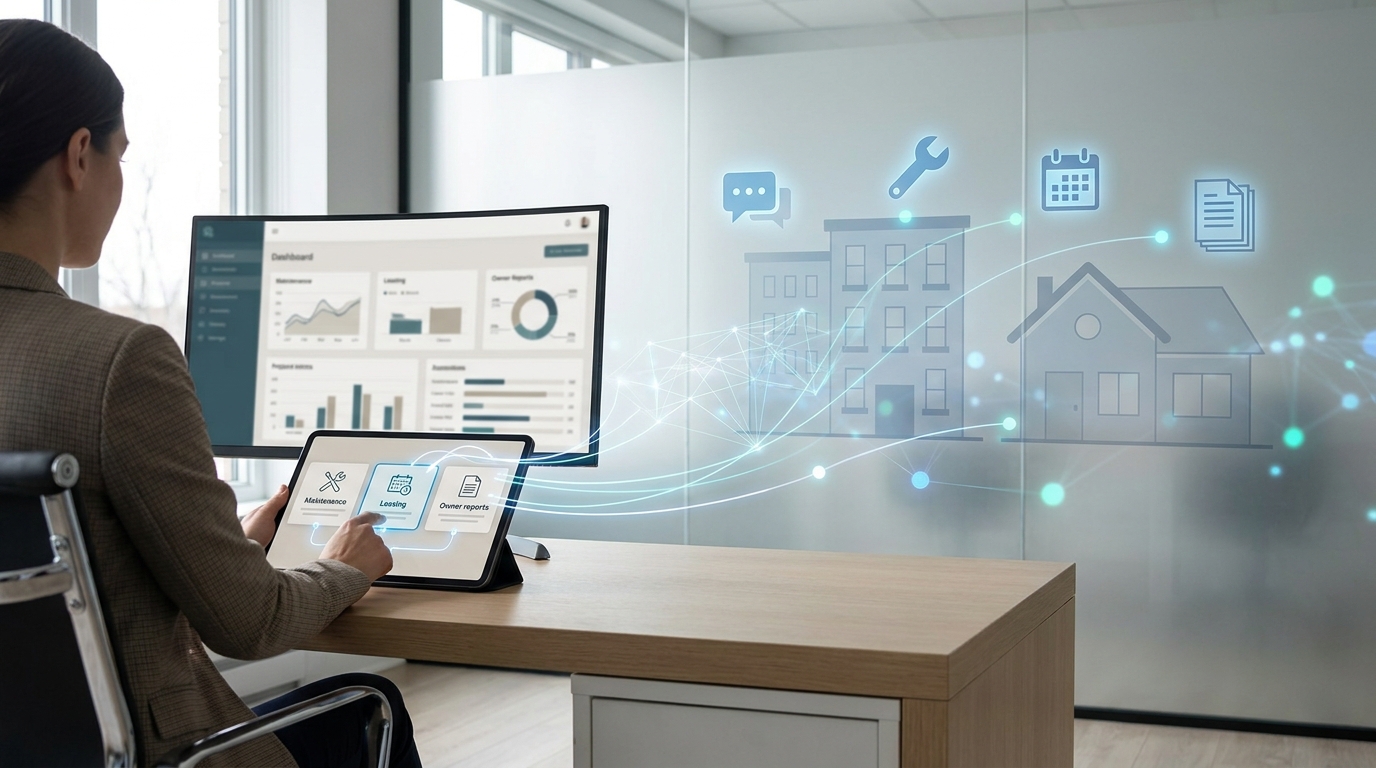
This article outlines eight integration-first AI opportunities for small-to-mid sized residential property management companies (often 200 to 5,000 doors). The goal is to connect existing tools rather than rip-and-replace your PMS.
Why an integration-first philosophy fits residential property management
Residential PM operations are typically a PMS plus a constellation of channels: resident portals, vendor email threads, after-hours phone calls, spreadsheets, and shared inboxes. The drag comes from translation work.
Unstructured to structured: turn resident messages into complete work orders.
Replies to schedules: convert vendor threads into confirmed appointments and status.
Invoices to bills: code, route, and post AP cleanly into the accounting ledger.
Activity to narrative: turn operational activity into owner-ready updates.
Because the PMS already holds leases, ledgers, work orders, and owner reporting, it should typically remain the system of record. AI becomes valuable when it can:
Read from the PMS and other channels to build context.
Convert messy inputs into structured actions.
Write back into the PMS so the record stays complete and auditable.
Opportunity 1: AI maintenance triage + auto work-order creation
The scenario you already know
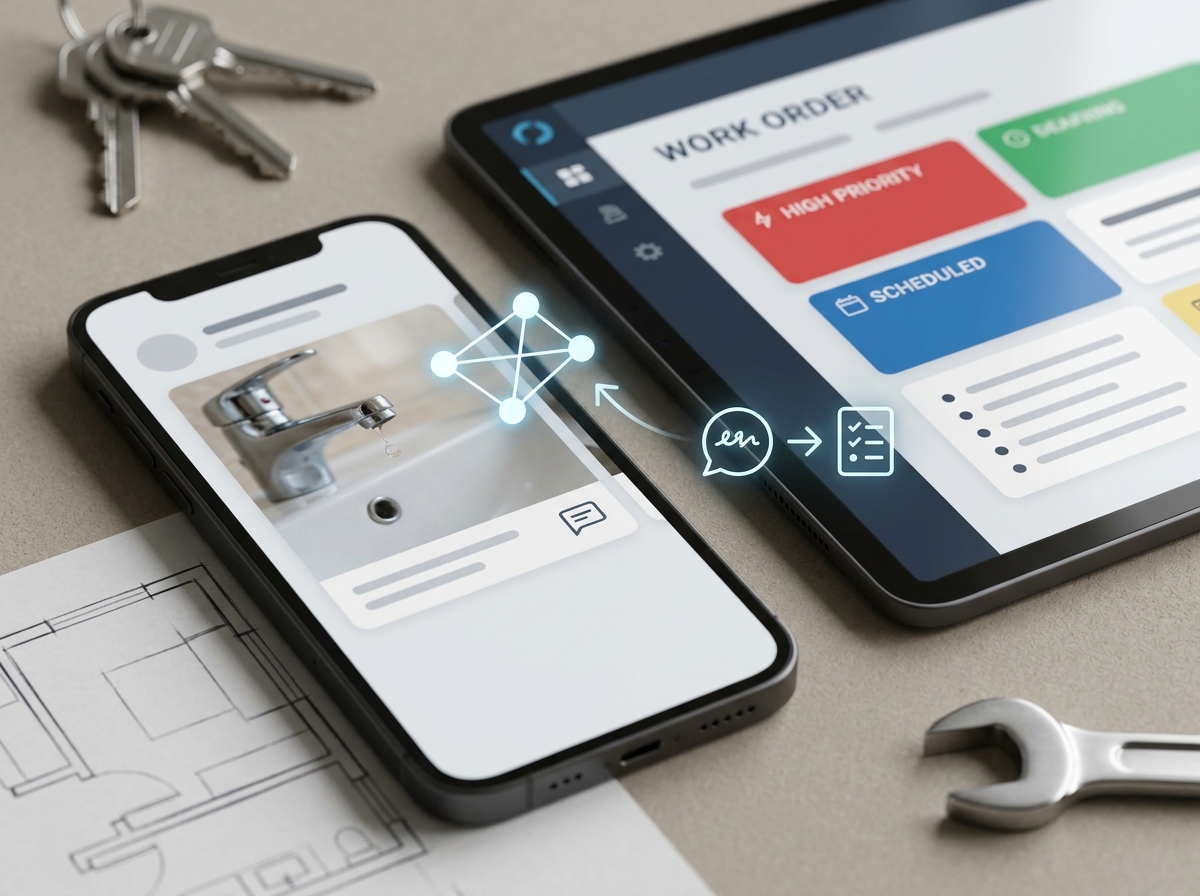
A resident texts "Water leaking under sink." Another emails a blurry photo of a ceiling stain. A voicemail says "No heat." Someone has to ask follow-up questions, determine urgency, identify the unit, and re-key the request into the PMS.
What an AI integration could do
Classify requests (HVAC, plumbing, electrical, appliance).
Detect emergency patterns and route appropriately.
Extract key fields (property/unit, permission to enter, pets, preferred times).
Ask follow-up questions so work orders are not created incomplete.
Create or update work orders inside the PMS and log communications.
Integration-first note: normalize intake from portal, email, SMS, and transcribed voicemail, then write back notes/attachments to the PMS so the record stays complete.
Opportunity 2: Vendor scheduling + status-update autopilot
Even after a work order exists, coordination is where time disappears: vendor availability, access confirmation, reschedules, and resident updates that prevent escalations.
Coordinate appointment windows by messaging preferred vendors.
Parse vendor replies to extract date/time and "needs parts" or "needs approval" signals.
Update status and timelines in the PMS.
Send proactive resident updates from approved templates via email/SMS.
Detect stuck work orders (no response, overdue completion, repeated reschedules).
Integration-first note: keep vendor conversations recorded in the PMS (or a connected log) so you retain a unified maintenance history.
Opportunity 3: Resident communication copilot (omnichannel inbox + policy-safe replies)
Resident messages arrive across email, SMS, calls, and portal messages. Many are repetitive, but risky topics like delinquency, notices, and fair-housing-sensitive questions require careful handling and consistent language.
Suggest replies grounded in your SOPs and templates.
Pull account context from the PMS (balance status, lease dates, open work orders).
Auto-handle low-risk FAQs with guardrails; route high-risk items to review.
Log communications back into the PMS for continuity and compliance.
Guardrails matter: avoid generating legal advice and explicitly escalate eviction-related communications or regulated notices to designated staff.
Opportunity 4: AI leasing inquiry-to-showing coordinator (lead-to-lease handoff automation)
Leasing teams lose time answering repetitive questions and coordinating showings. Response speed and follow-through can influence showing rates, no-show rates, and vacancy days.
Respond instantly to inquiries with policy-accurate info (pet policy, fees, screening criteria).
Schedule showings using calendar availability, buffers, and reminders.
Nudge applicants for missing documents and next steps.
Write back statuses to the PMS so the pipeline is visible to the team.
Integration-first note: connect inbound leads (listing sites, web forms, email, missed calls), calendars (Google/Microsoft), and PMS endpoints for applicants/applications.
Opportunity 5: Application fraud-check + consistent screening workflow assistant
Fraud pressure increases manual review work and process inconsistency. Documents arrive via portal uploads and email, and screening packets end up scattered across inboxes and drives.
Standardize the workflow with a checklist so decisions are consistent.
Extract structured fields from IDs, pay stubs, and letters.
Flag anomalies for human review (mismatches, missing pages, suspicious formatting).
Assemble an auditable packet attached to the applicant record.
Integration-first note: keep humans in the loop. The goal is consistency and better documentation, not fully automated approvals.
Opportunity 6: Invoice intake (AP) automation + coding and approval routing
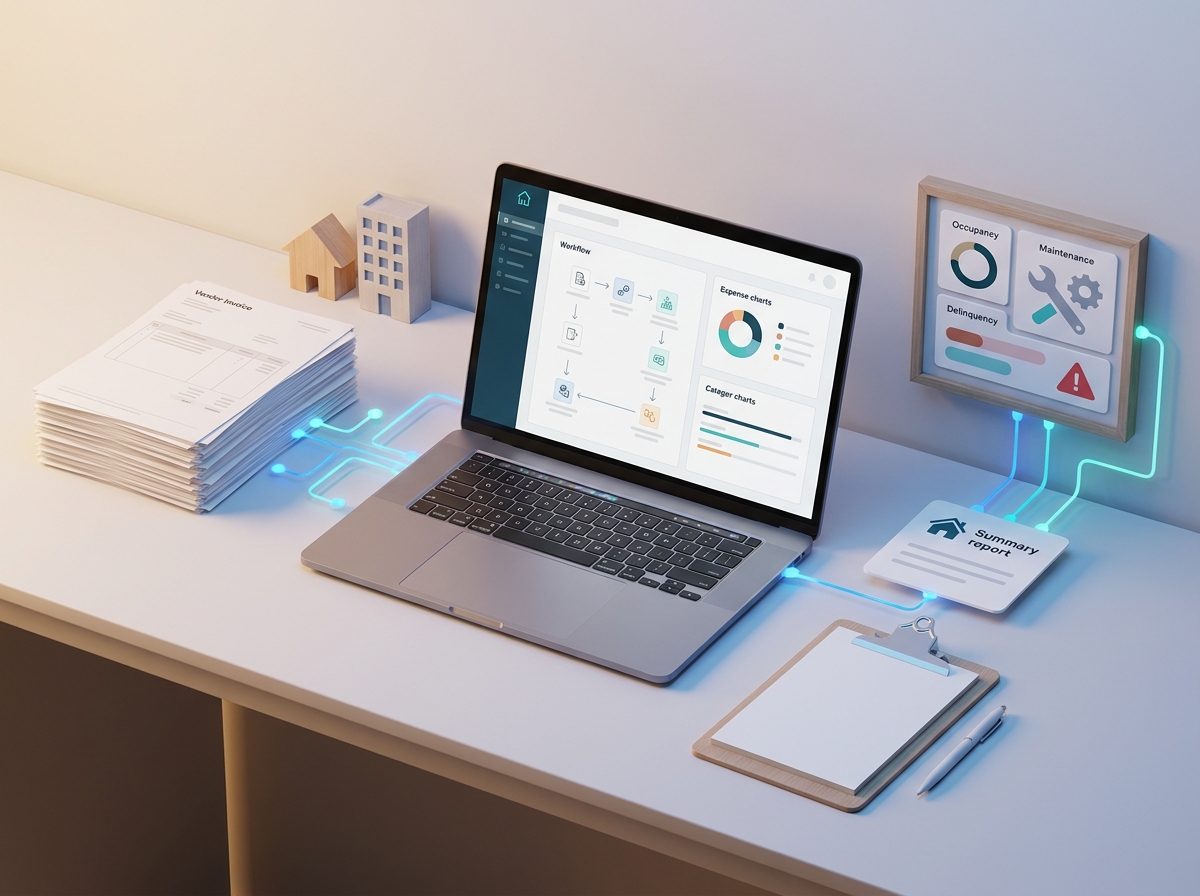
Accounts payable is a quiet margin killer. Invoices arrive as PDFs, photos, or scans. Someone saves attachments, enters bills, assigns vendors and properties, codes expenses, prevents duplicates, routes approvals, and handles exceptions at month-end.
Ingest invoices from an AP mailbox and uploads.
Extract invoice fields (header + line items) into a structured bill object.
Match to vendor/property/work order to reduce manual lookup.
Suggest GL coding based on vendor history and your chart of accounts.
Detect duplicates and inconsistent amounts.
Route approvals with thresholds and log the audit trail, then post approved bills into the PMS ledger.
Integration-first note: design for exception handling and auditability by storing the source invoice and recording who approved what, when.
Opportunity 7: Turnover and make-ready orchestrator (move-out to inspection to work to listing)
Turns are where coordination debt compounds. Move-out dates, inspection scheduling, photos, scope of work, vendor dispatch, utilities, cleaning, keys, and listing go-live often live in different tools and checklists.
Detect upcoming move-outs and create a standardized turn plan.
Generate task lists across leasing, maintenance, and admin roles.
Collect inspection data + photos via mobile forms and auto-tag issues.
Draft scope of work and route it for approval, then trigger bids and scheduling.
Notify leasing when market-ready and start listing steps.
Integration-first note: connect lease end dates and move-out events in the PMS with tasks/work orders and controlled photo storage linked back to the record.
Opportunity 8: Owner weekly digest + executive portfolio intelligence
Owners want narrative, not just raw reports. They ask what changed, what is stuck, and what decisions are needed. Many teams assemble this under time pressure by pulling PMS reports and checking email threads.
Compile per-owner digests (leasing status, open/aged work orders, turns, delinquency signals, renewals).
Highlight exceptions and approvals needed (vendor delays, thresholds, variances).
Provide leadership a portfolio view of bottlenecks and trends.
Integration-first note: position this as structured summaries generated from existing data, with optional human review before sending.
Implementation strategy: start small, integrate deeply
AI projects tend to fail when they try to do everything at once. An integration-first roadmap should sequence risk, adoption, and measurable impact.
1) Choose one workflow that is high-volume and high-friction
Many teams start with maintenance intake (high message volume, clear structured outputs) or invoice intake/AP (high repetition, measurable cycle time).
2) Define the system of record and the write-back rules
Define what is authoritative for work order status, bills, applicant status, and comms logs.
Define what AI can write automatically vs. what requires approval.
Document exception handling so edge cases do not create shadow processes.
3) Start with draft mode and human-in-the-loop
A safe early phase is AI drafting responses, classifications, and coding suggestions while humans approve or edit. This builds trust and surfaces policy gaps.
4) Move to limited autopilot with templates and guardrails
Once confidence is higher, expand into limited autopilot for low-risk FAQs, missing-details requests, and invoice routing under thresholds. Keep high-risk actions (legal notices, high-dollar approvals, lease decisions) human-led.
5) Instrument the workflows with operational KPIs
Time to first response (maintenance and resident communications).
Touches per work order plus work order aging and cycle time.
AP cycle time (received to entered to approved to paid).
Turn time (move-out to market-ready to leased).
6) Prioritize auditability and compliance
Residential property management is documentation-heavy. A dependable AI layer should attach source documents and message threads to records, record who approved what and when, preserve templates and policy constraints, and make it easy to reproduce why a decision was made months later.
Conclusion: AI should connect the last mile, not replace your PMS
For small-to-mid sized residential property management companies, the most practical AI wins are rarely about adopting a brand-new platform. They are about integrating AI into the workflows where growth creates administrative overload: maintenance intake, vendor coordination, resident communications, leasing handoffs, screening, invoice processing, turn orchestration, and owner reporting.
If your team is managing more doors but feels like it is doing more swivel-chair work than ever, an integration-first roadmap is a practical next step: start with one workflow, integrate deeply with your PMS, keep humans in the loop, and expand only after the system proves it can improve speed and consistency without compromising compliance.
If you want help mapping these opportunities to your current tool stack and identifying a safe first workflow that can be implemented without disruption, a consultation could be a practical next step.