
AI Integration Opportunities for Residential Property Management: An Integration-First Guide for Scaling Without Replacing Your PMS
- Sam Weinstein
- Apr 13
- 11 min read

Explore practical AI integration opportunities for residential property managers—communications, maintenance, leasing, renewals, accounting, and reporting—without replacing your PMS.
Introduction: When “More Doors” Starts to Feel Like More Chaos
Picture a familiar Monday morning inside a growing third‑party residential property management firm.
The shared inbox already has dozens of threads: residents asking about rent status, owners requesting explanations of charges, vendors confirming appointments, applicants wanting a showing, and someone reporting a possible water leak.
The phone line shows a backlog of voicemails from the weekend.
A maintenance coordinator is trying to turn scattered texts and photos into structured work orders.
Accounting is chasing invoices for month‑end close.
The operations leader is asking the same question they asked last quarter: “How do we handle more units under management (UUM) without burning out our team or lowering service quality?”
In this environment, the most pressing problem is rarely that your property management system (PMS) “can’t do enough.” Most teams already have a system of record—AppFolio, Buildium, Yardi (including Breeze), Rent Manager, Propertyware, or similar—plus a patchwork of email, SMS, portals, e‑sign tools, and document storage.
The operational drag often comes from what sits between those systems:
Information arrives unstructured (emails, texts, calls, photos).
Staff re‑enter details across tools.
Context is fragmented (“who said what” across channels).
Policy enforcement varies by person.
Work scales faster than headcount.
That is why an integration‑first AI philosophy is worth exploring.
Rather than “replacing staff” or “ripping and replacing the PMS,” the more grounded opportunity is to treat AI as a coordination layer:
It should connect your existing tools.
It should turn messy inputs into structured records.
It should draft, route, and summarize.
It should keep humans in control for financial and customer‑facing decisions.
The sections below outline AI integration opportunities that property management companies should explore—especially those managing roughly 200–5,000 units—while keeping the PMS as the system of record.

Why AI Integration (Not Replacement) Fits Residential Property Management
Residential property management is a high‑volume service business where performance is shaped by throughput, consistency, and response time.
As portfolios grow:
Communications volume increases nonlinearly. More doors typically means more maintenance requests, more late payments, more renewal touchpoints, and more exceptions.
Tribal knowledge becomes a liability. A few senior team members may hold key policy and vendor process knowledge, which becomes hard to replicate across new hires.
After‑hours load becomes a burnout multiplier. Emergencies and anxious residents do not respect office hours.
Owner expectations rise with professionalization. Owners want timely, plain‑language explanations—not just ledger lines.
In that context, AI tends to be most useful when it is designed to:
Retrieve the right context (lease clauses, account status, work order history, vendor notes, property rules).
Convert communications into actions (tasks, notes, work orders, approvals, follow‑ups).
Standardize language and process (templates, policy‑guided responses, consistent documentation).
Route exceptions to humans (low confidence, high risk, policy deviation).
This is less about chasing a “magic AI platform” and more about connecting what you already use.
Opportunity 1: AI Inbox + Phone Triage (“Resident Services Copilot”)
The operational bottleneck
A common pain point for mid‑market property management teams is the inbox + phone triage loop.
Residents ask repetitive questions: rent received, late fees, portal access, work order status, lease rules.
Owners ask for explanations that require digging through ledgers, invoices, and work orders.
Vendors request access info, approve scheduling windows, or ask clarifying questions.
Staff members switch contexts constantly and copy/paste responses.
What an integration‑first AI layer could do
A “Resident Services Copilot” should be designed as a drafting and routing system, not an autonomous customer service replacement.
Potential capabilities to consider:
Message classification: categorize inbound messages by intent (maintenance, payment, leasing, complaint, portal help, owner question).
Context retrieval: pull relevant details from the PMS and document storage (lease summary, resident ledger status, work order timeline, property rules).
Draft responses: generate policy‑compliant drafts that staff can approve, edit, or reject.
Routing and task creation: send the inquiry to the right queue (leasing, maintenance, accounting) and create a task or note in the PMS.
Call/voicemail transcription: summarize calls and attach the summary to the resident or owner record, improving “who said what” traceability.
Integration points (without replacing systems)
An implementation might integrate:
Google Workspace or Microsoft 365 shared inbox
SMS provider (or an existing texting platform)
Resident portal message exports/webhooks (where available)
VoIP call recordings/voicemail
PMS notes/tasks/communications log APIs (when supported)

Governance that reduces risk
Because communications are high‑visibility, a safer approach usually includes:
Human‑in‑the‑loop approvals: for outbound messages, at least in early phases.
Template + policy grounding: drafts anchored to approved templates, SOPs, and lease/policy snippets.
Confidence thresholds: low confidence drafts route to human review automatically.
What success might look like
A property management team could track:
First response time (FRT)
Average handle time (AHT)
Percentage of inquiries resolved without escalation
After‑hours inquiries that reach on‑call staff
Internal QA score for policy/tone consistency
Opportunity 2: Maintenance Intake → Structured Work Orders + Automated Follow‑Up
The operational bottleneck
Maintenance is often the loudest operational pain because it touches resident satisfaction, vendor management, owner trust, and after‑hours emergencies.
The problem is not only the number of work orders—it is the shape of the information:
Requests arrive via text/email/portal with incomplete details
Photos are attached with little context
Urgency is unclear
Follow‑up questions consume time
Vendor coordination becomes an ongoing chase
What an AI “maintenance intelligence layer” could do
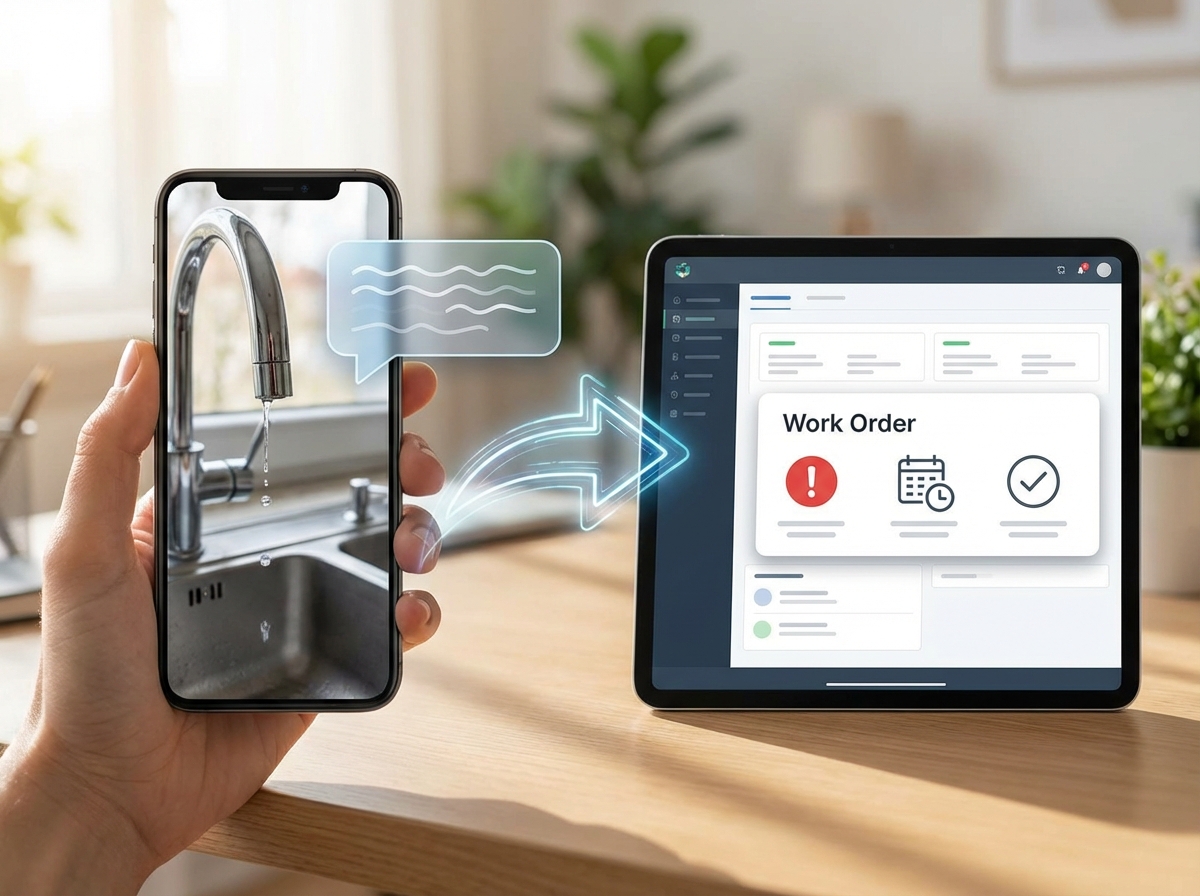
An integration‑first approach should explore AI as a translator between messy resident input and a standardized work order.
Possible workflow components:
Issue classification: plumbing vs HVAC vs electrical vs appliance vs pest, etc.
Entity extraction: property/unit, resident, symptoms, timing, access constraints, pet info.
Missing‑info collection: automated follow‑up questions (e.g., “Is the water shutoff accessible?” “Any active leaking right now?” “Best access times?”).
Emergency detection: combine rules + AI signals to escalate emergencies (active leak, no heat in winter, gas smell) to the correct on‑call procedure.
Work order creation: create a complete work order in the PMS with structured fields and attachments.
Resident status updates: send simple, consistent updates at key milestones (scheduled, technician en route, completed, waiting on parts).
Integration points
This layer could connect:
Email/SMS/portal intake
File storage for images/video
PMS work order creation APIs or approved import patterns
Vendor outreach via email/SMS
Human control remains essential
Maintenance has safety, cost, and liability implications. Sensible safeguards to consider:
Immediate escalation protocols for emergencies (AI assists; humans decide)
Approval checkpoints for large repairs or owner‑approval thresholds
Audit logs of what the AI inferred and which questions it asked
What success might look like
Metrics that are often practical to measure:
Time from request → work order created
Percentage of work orders created with complete required fields
Work order cycle time (open → closed)
Resident “status check” messages (volume and trend)
Emergency escalations handled within internal SLA targets
Opportunity 3: Leasing Lead Concierge (Listings → Q&A → Showing → Application Hand‑Off)
The operational bottleneck
Leasing teams frequently spend time on repetitive questions, coordinating showings, reminding applicants about documents, and moving leads between tools. When inquiries spike, responsiveness can drop—exactly when speed matters.
What an AI leasing concierge could do
A leasing concierge should operate as an integrated assistant that improves response and scheduling consistency.
Opportunities to consider:
Property‑specific Q&A: grounded in listing data, policies, and approved FAQs.
Lead qualification: basic screening questions aligned to your stated criteria (without making decisions that create fair housing risk).
Showing scheduling: propose times and confirm appointments by integrating with calendars/scheduling tools.
Application readiness: send checklists and reminders (ID, pay stubs, etc.) and hand off cleanly to the leasing pipeline.
Integration points
A realistic integration might connect:
PMS listing feed and availability status
Website chat widget and/or SMS
Google/Microsoft calendar
Screening provider links and application workflow
Compliance considerations
Leasing touches fair housing and regulated processes. Integration design should include approved scripts and templates, avoidance of prohibited decisioning language, and clear escalation to humans for exceptions or sensitive questions.
What success might look like
Possible measures include:
Lead response time
Inquiry → showing conversion rate
Showing → application conversion rate
Days on market / vacancy days (tracked carefully)
Leasing labor hours per signed lease (where measurable)
Opportunity 4: Renewals + Notices Orchestrator (Policy‑Guided)
The operational bottleneck
Renewals are calendar‑driven and easy to miss under operational load.
Typical manual steps include:
Monitoring upcoming expirations
Calculating renewal offers and rent increases
Generating notices and renewal packets
Chasing signatures
Updating multiple systems
A missed window can create avoidable vacancy and administrative chaos.
What an AI‑supported renewal workflow could do
This opportunity should explore AI as a drafting and orchestration tool under clear policy constraints.
Potential capabilities:
Daily lease expiration monitoring: pull lease end dates and resident status from the PMS.
Rules‑guided recommendations: identify the correct renewal window and route exceptions (delinquency, performance issues, owner constraints) for manager review.
Draft renewal communications: generate emails/SMS using approved templates and resident/property context.
Packet generation: assemble renewal letters, addenda, fee schedules, disclosures.
E‑sign coordination: send via DocuSign/Adobe Sign, store executed docs in Drive/SharePoint, and link back to the PMS.
Integration points
The orchestrator can sit on top of:
PMS lease data exports/APIs
E‑sign provider
Document storage
Communications channels (email/SMS)
What success might look like
Teams could track:
Renewal offers sent on time (within policy window)
Renewal conversion rate (segmented appropriately)
Manual touches per renewal file
Opportunity 5: Vendor Invoice Capture + Work‑Order Matching + GL Coding Assistant
The operational bottleneck
Accounting and operations often collide in the invoice workflow: invoices arrive as PDFs, details must be keyed into accounting modules or QuickBooks, invoices must be matched to work orders and properties, and approvals require context.
Month‑end becomes a recurring stress test.
What an AI invoice assistant could do
An AI‑supported AP workflow should explore the following integration steps:
Invoice ingestion: monitor an AP inbox and pull attachments.
OCR + data extraction: vendor, invoice number, date, line items, amounts, property address/unit.
Work order matching: match by vendor + property + work order number + timing/amount similarity.
Duplicate detection: flag duplicates or suspicious splits for review.
GL coding suggestions: use historical coding patterns and enforce rules (capex vs repair, job cost fields).
Approval routing: send an approval request with context (linked work order, photos, notes) via email/Teams/Slack.
Posting: push to the PMS accounting module or QuickBooks via API/import.
Integration points
This can be implemented without replacing accounting systems by connecting:
AP inbox
OCR/document processing
PMS work order data
Accounting system entry (API or import)
Approval workflow in tools your team already uses
What success might look like
Potential metrics:
Invoice processing time (receipt → posted)
Coding correction rate
Duplicate invoice rate detected
Month‑end close duration
Owner inquiries about charges (volume and resolution time)
Opportunity 6: Owner Reporting Narrative + “Explain My Statement” Assistant
The operational bottleneck
Owners do not experience property management as a ledger—they experience it as outcomes: occupancy, maintenance responsiveness, financial performance, and clarity/trust.
Many owner questions are reasonable but time‑consuming:
“Why was this charge higher than normal?”
“What happened with that HVAC issue?”
“What did we do this month that impacted cash flow?”
Answering those questions often requires staff to assemble a story from multiple records.
What an AI owner reporting layer could do
This opportunity should explore two complementary integrations:
Monthly narrative generation: a plain‑language “what happened this month” recap grounded in ledger transactions, work order history, and leasing activity.
Statement explanation assistant: a controlled Q&A workflow that drafts answers to owner emails based on retrieved facts (not guesses).
The goal is not to invent explanations—it is to compile and translate existing system data into human‑readable language.
Governance: accuracy over fluency
Owner communications can create trust or damage it. Safety patterns to consider:
Retrieval‑augmented generation (RAG): answers limited to pulled records.
Audit log: what sources were used in each generated draft.
“Unknown” behavior: if data is missing, route to a human rather than improvising.
What success might look like
Possible measures include:
Owner emails/calls per door
Time spent on owner communications
Owner churn/retention trends (over longer windows)
Internal quality checks for explanation accuracy and tone
Opportunity 7: Portfolio Health “Early Warning System” (Delinquency, Vacancy, Maintenance Backlog, SLA)
The operational bottleneck
Most property management firms have reports. Fewer have systems that detect issues early, translate signals into clear action steps, and prevent small exceptions from becoming escalations.
As portfolios grow, leaders often discover problems late:
Delinquency creeping upward
Turns taking longer than expected
Maintenance backlog aging
Inbox backlog increasing
Repeated complaints at a specific property
What an AI‑supported early warning system could do
This opportunity should explore AI as a monitoring and orchestration layer—not as a replacement for reporting.
Possible components:
Cross‑system data coordination: nightly pulls or webhooks from PMS + communications + accounting.
Rules + anomaly detection: thresholds for delinquency spikes, work order aging, turn time, unanswered inbox aging.
Action plan generation: draft payment reminders, create escalation tasks, prompt vendor re‑dispatch, route exceptions to managers.
Digest outputs: deliver daily/weekly summaries in email/Teams/Slack plus dashboards in a BI layer (Looker Studio/Power BI).
What success might look like
Potential metrics include:
Days delinquent and delinquency rate trends
Average work order age and SLA compliance
Turn time (move‑out → ready)
Inbox backlog aging
Complaint volume and review patterns (interpreted carefully)
A Practical Implementation Strategy: Start Small, Integrate Deeply
The most effective AI work in property management is often less about model selection and more about workflow design.
Below is an implementation approach that emphasizes integration over replacement.
1) Choose your “system of record” (and keep it)
Most firms already have a PMS that represents the authoritative record for residents and leases, work orders, ledgers and owner statements, and tasks/notes.
An AI integration initiative should treat the PMS as the “truth layer.” The AI’s job is to retrieve context from the PMS, write structured updates back (where allowed), and maintain a consistent audit trail.
2) Map high‑volume workflows before touching AI
AI adds the most value when you can clearly define inputs, required fields, policy boundaries, escalation rules, and outputs.
In residential property management, high‑volume candidates often include:
Maintenance intake and follow‑ups
Resident/owner inbox triage
Renewals and notices
Invoice capture and coding
3) Start with one channel + one workflow + one team
A realistic MVP might be one inbox (resident services), one PMS integration path (read‑only at first), one set of common intents (10–20), and one team as the pilot group.
4) Use “human‑in‑the‑loop” as a feature, not a compromise
Property management has real stakes: resident safety, legal compliance, financial accuracy, owner trust. Early implementations should treat human review as a design principle: drafts, not auto‑sends; suggested coding, not auto‑posting; recommended actions, not autonomous decisions.
5) Ground AI outputs in policy, templates, and retrieved facts
To avoid “confident but wrong” outputs, teams should explore templated language blocks, SOP checklists, retrieval from approved documents (lease templates, policy manuals, vendor SOPs), and explicit source visibility in the internal UI.
6) Instrument the workflow with measurable operational metrics
Before building, define what you will measure: response times, cycle times, touches per case, backlog aging, exception rates, and correction rates.
7) Address data privacy, access control, and auditability early
Property management data includes personal information and financial details. Any AI integration should incorporate role‑based access controls, logging of who approved/sent what, retention policies for transcriptions and summaries, and secure handling of documents and attachments.
8) Plan change management as carefully as the technology
The best integrations fail when staff don’t trust drafts, workflows are unclear, or leadership does not enforce usage. Consider SOP updates, training on edge cases, and feedback loops from frontline staff.
How to Prioritize These Opportunities (A Suggested Sequencing)
While every firm differs, an integration‑first roadmap often prioritizes:
Maintenance intake → structured work orders (high volume, measurable cycle time)
Inbox + phone triage copilot (reduces context switching and improves consistency)
Invoice capture + matching + GL coding (reduces month‑end pain and owner statement errors)
Leasing concierge (improves responsiveness and may impact vacancy)
Renewals orchestrator (reduces missed windows and administrative load)
Owner reporting narrative + statement explanation (reduces owner support load)
Portfolio health early warning system (improves proactive operations)
Conclusion: AI Should Make Your Existing Stack Work Better Together
For independent and regional residential property management firms, the most practical AI opportunities are often integration opportunities.
Rather than replacing your PMS, a well‑governed AI “coordination layer” should help you triage and respond more consistently, convert maintenance intake into complete work orders, reduce leasing friction, orchestrate renewals, process invoices with better matching and coding, generate owner‑friendly narratives grounded in real records, and monitor portfolio health proactively.
If you want a practical assessment of where AI integrations could fit into your current stack (AppFolio/Buildium/Yardi/other + email/SMS/phone + e‑sign + document storage), consider scheduling a consultation to map one high‑impact workflow and define an MVP that keeps humans in control.
Comments