
AI Integration Opportunities for SMB Residential Property Management: 7 Integration-First Workflows (Without Replacing Your PMS)
- Sam Weinstein
- Apr 6
- 7 min read

If you manage a growing portfolio of long-term rentals—say a mix of single-family homes and small-to-mid multifamily—you likely recognize the pattern: the shared inbox never empties, leasing follow-ups compete with owner questions, and maintenance requests arrive at the exact moment your team tries to close the month.
At a certain scale (often somewhere between a few hundred and a few thousand doors), the issue is not that your team lacks effort or expertise. It is that the work becomes coordination-heavy.
This is where AI can be useful—provided it is framed correctly. For most SMB residential property management companies, the practical opportunity is not to replace the property management system (PMS). AppFolio, Buildium, Yardi Breeze/Voyager, Rent Manager, DoorLoop, and similar platforms already hold the ledger, the work orders, the leasing pipeline, the owner statement workflow, and sometimes trust accounting requirements.
A more realistic and lower-risk philosophy is integration-first: AI should function as an automation and intelligence layer that connects the tools you already use, standardizes messy inputs, drafts or routes the next step, and writes the right information back into the PMS as the system of record.
Below are seven AI integration opportunities property management leaders should explore. The tone here is intentionally theoretical: these are opportunities to consider, design patterns to evaluate, and metrics to define—rather than promises of specific results.
Why an integration-first approach fits property management
Property management is a workflow business. Your advantage is not only local market knowledge or vendor relationships; it is your ability to consistently execute the same core processes at volume:
Leasing: lead response, showings, applications, screening, onboarding
Operations: maintenance intake, triage, vendor coordination, resident updates
Accounting: invoice coding, approvals, owner statements, exception handling
Risk and compliance:: documentation, notices, fair-housing-safe communication
AI tends to help most when it reduces friction in the in-between moments: the repetitive messages, the missing details, the follow-up nudges, and the status updates that do not require high judgment—yet still require consistency and documentation.
An integration-first AI design typically assumes:
The PMS stays the system of record. Work orders, ledgers, and resident/owner records should live where staff already work.
AI focuses on intake, extraction, drafting, routing, and summarization. These are high-volume, lower-risk capabilities.
Human-in-the-loop controls exist for financial and legal actions. AI can draft; people approve.
Every automation produces an audit trail. Notes, attachments, and message transcripts should be logged back to the PMS (or a designated ticket record).
With that frame, let’s explore seven opportunities.
Opportunity 1: AI maintenance concierge (omni-channel intake to structured work orders)
The scenario to recognize
Maintenance requests rarely arrive cleanly. A resident sends a vague portal message ("AC not working"). Another leaves a voicemail with no unit number. A third texts after hours: "water heater leaking!!!" Your maintenance coordinator’s first job is not dispatch. It is to collect details, assess urgency, and document everything in the work order.
The opportunity to consider
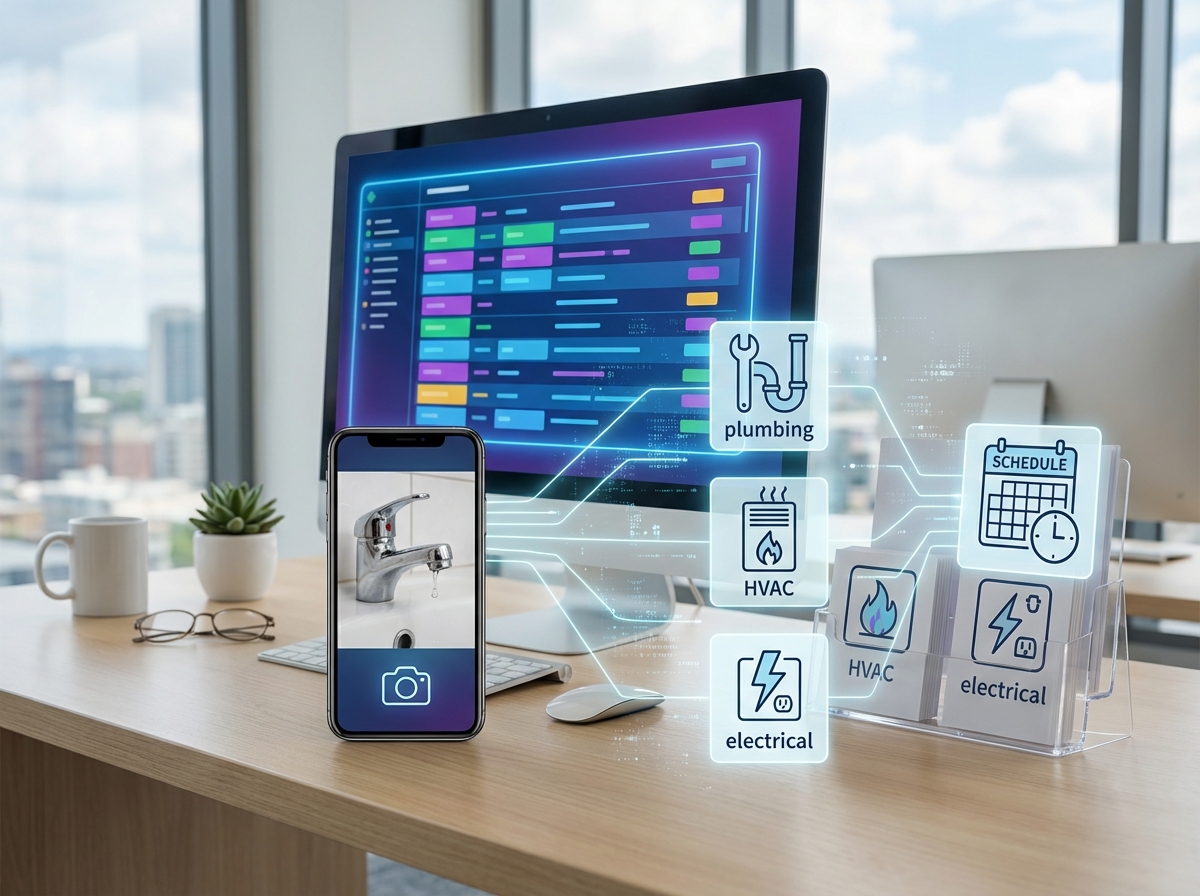
An AI maintenance concierge could act as a front-door intake layer that:
Monitors inbound channels: portal messages, shared inbox, SMS, voicemail transcripts, website chat
Asks structured questions: photos, access instructions, permission to enter, pets, best scheduling windows
Classifies urgency: including habitability and safety signals
Creates or updates a work order in the PMS: clean fields and attachments
Sends a status acknowledgment: resident + internal routing
Where it should integrate (without replacing the PMS)
Inputs often include Gmail/Microsoft 365 shared inboxes, SMS via Twilio, VOIP transcripts, and portal exports. Orchestration can sit in a workflow engine (n8n/Make/Zapier) with SLA timers and escalation rules. The output should write back to the PMS (create the work order, attach resident photos, and log the conversation as notes).
Potential benefits to measure
Median time-to-first-response on new maintenance requests
Percent of work orders created with complete intake data on first pass
Coordinator touches per work order
Guardrails worth designing
Hard escalations for safety keywords: gas smell, sparks, flooding
Clear resident disclosures: and an easy path to reach a human
Conservative defaults: if AI cannot classify confidently, route to staff
Opportunity 2: vendor scheduling and follow-up autopilot (dispatch, confirmations, NTE approvals)
After triage, coordination expands: vendor selection, appointment scheduling, not-to-exceed (NTE) limits, owner approvals, and the ongoing "where are we on this?" loop. In many SMB firms, this creates a large volume of outbound calls and texts.
A vendor scheduling and follow-up autopilot could recommend vendors by trade and geography; dispatch via SMS/email and parse replies into scheduling fields; confirm appointments with residents (including access and pet notes); route NTE and owner approvals; nudge vendors for completion photos and invoice status; and write status updates back into the work order timeline in the PMS.
Guardrails: an escalation ladder for non-responsive vendors, plus rules for when staff must approve dispatch (habitability issues, new vendors, high-value owners).
Opportunity 3: resident communications copilot (policy-aware replies with auditability)
Resident communication is high-volume and often repetitive: rent receipts, portal login issues, keys and locks, parking rules, pet policies, office hours, and status updates. The risk is inconsistency: a single inaccurate fee explanation or poorly worded message can create downstream disputes.
A communications copilot could draft responses based on a property-manager-controlled knowledge base (lease templates, addenda, fee schedules, house rules, emergency procedures), detect and escalate sensitive topics, and log every interaction to the resident record or related work order as part of the audit trail.
Guardrails: draft-only mode for legally sensitive messages and a clear ownership and review cadence for the knowledge base.
Opportunity 4: leasing pipeline autopilot (lead response, showings, and application completion)
Leasing is where responsiveness directly affects vacancy days. When leads arrive after hours or during a busy maintenance day, follow-up delays can turn into missed showings. Once an applicant begins, missing items (ID, pay stubs, consent forms) create a long tail of manual chasing.
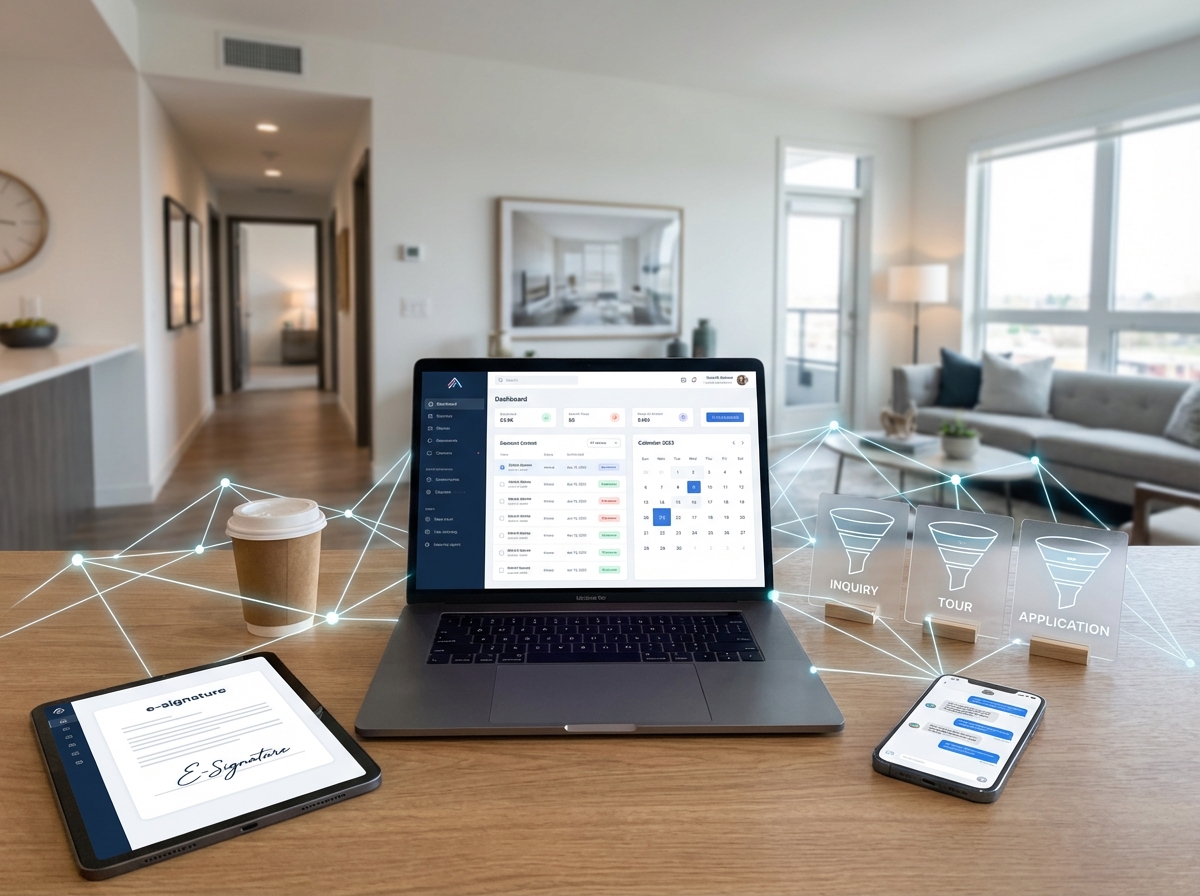
A leasing autopilot could respond immediately to inbound leads from listing portals, website forms, or inbox; collect basic qualification information in a policy-neutral way; offer showing times via scheduling integration; send reminders and directions; run an application completion checklist through secure upload links; and write updates back to the leasing pipeline stage inside the PMS.
Guardrails: fair-housing-aligned language controls, human review pathways for exceptions, and consent and privacy controls for documents.
Opportunity 5: invoice and bill processing assistant (OCR, GL coding suggestions, anomaly flags)
Accounts payable is relentless: invoices arrive as PDFs, emailed images, or portal uploads. Staff manually re-key amounts, select GL codes, match to properties and work orders, and route approvals—often under month-end close pressure.
An invoice processing assistant could extract invoice data, suggest property and work order matches, recommend GL codes based on vendor history and prior patterns, flag anomalies (duplicates, unusual amounts, missing approvals), and create a draft bill in the PMS with the invoice attached—pending human approval.
Guardrails: human approval for payments, plus audit logs for extracted fields and suggested coding.
Opportunity 6: delinquency and collections workflow orchestrator (segmentation, nudges, tasking)
Delinquency follow-up is repetitive, emotionally draining, and often poorly documented. Accounting needs consistent notes for promises-to-pay and disputes, while owners want clear updates.
A delinquency workflow orchestrator could pull aging and ledger data from the PMS, segment accounts by rules and history (for example, first-time late vs chronic late), send compliant reminder sequences via email/SMS with payment options, create tasks for human escalation, and log all outreach and resident replies back into the PMS for auditability.
Guardrails: compliance review of templates, stop conditions for handoff, and respectful language controls.
Opportunity 7: inspection and move-in/move-out documentation intelligence (photos to punch lists)
Inspections and turns are documentation-heavy. Move-in photos, condition notes, and move-out findings often live in inconsistent formats. Later, during deposit disposition or a dispute, teams scramble for evidence. Make-ready speed depends on clear punch lists and fast work order creation.
Inspection documentation intelligence could standardize inspection templates, tag and organize photos, summarize findings into a punch list by trade, draft chargeback documentation packets with photos and timestamps, and create make-ready work orders with documentation written back to the unit record.
Guardrails: human review of chargeback recommendations, retention policies for photos, and privacy practices.
Implementation strategy: how to approach AI integration without disruption
AI initiatives in SMB property management tend to work best when treated as workflow design projects, not “software installs.” A practical approach often includes:
1) Start with one workflow and one measurable baseline
Choose a workflow you touch daily and can measure: maintenance intake, resident communications, leasing follow-ups, or invoice entry. Define baseline metrics (response time, cycle time, touches) before changing anything.
2) Map the handoffs and exceptions
Property management is full of exceptions: emergency vs non-emergency maintenance, owner approval thresholds, vendor availability, and resident access constraints. Mapping these exceptions early helps you decide where AI should automate versus where it should route to staff.
3) Design for write-back and audit trails
If AI only drafts in a separate tool, you risk copy-paste workflows and incomplete records. Prioritize logging notes, attaching transcripts, and updating statuses back in the PMS so your team retains a single source of truth.
4) Use human-in-the-loop approvals for risk zones
For fair housing-sensitive language, legal notices, and financial actions, AI should draft and summarize, while humans approve. This design reduces workload without creating new liability.
5) Pilot in a controlled segment before scaling
A conservative pilot could focus on one region, one property type, or one trade (for example, non-emergency plumbing). Pilots allow you to tune escalation rules and verify that automations behave as intended.
6) Govern your knowledge base and templates
Policies, fee schedules, and procedures change. Assign ownership, set review cycles, and maintain a change log so your AI assistants do not drift over time.
What success should look like (beyond using AI)
Rather than measuring AI adoption as an end in itself, property managers may want to track operational outcomes that correlate with service quality and profitability:
Faster first-response times for residents and leads
More complete work orders at intake
Shorter work order cycle times
Fewer vacancy days due to improved leasing responsiveness
Lower rework and fewer exceptions in accounts payable
Cleaner, more consistent audit trails for disputes and owner questions
Conclusion: a practical roadmap property managers should explore
AI in residential property management is most credible when framed as an integration opportunity: a way to connect your PMS, communication channels, vendors, and documents into more consistent workflows.
If you are considering AI, a practical next step is to pick one workflow, define baseline metrics, and design a small pilot that keeps AppFolio, Buildium, Yardi, Rent Manager, or DoorLoop as the system of record. From there, you can expand the integration layer gradually—without forcing your team to relearn their entire operating system.
If you would like a second opinion on where to start (and what an integration-first pilot could look like in your current stack), consider scheduling a discovery call. A short process review is often enough to identify where AI support could be safest and most valuable.
Comments